
The Queen, the Mistress and Nelson’s Folly
A visit to Naples was always going to stir thoughts of my ancestor Fanny Nelson, her husband naval hero Lord Horatio Nelson and his controversial relationship with Emma Hamilton. But I had not expected it to raise a more intriguing question: what was the role of Queen Maria Carolina of Naples? Histories have portrayed her as a weak and foolish figure, but after my investigations into Fanny, I’m more likely to question such stereotypes. Walking through the palaces and fortresses that still dominate Naples and Caserta, I began to suspect the real story was far more interesting than the old caricature.

From Rome to Naples
It all began when I recently travelled with my choir to Rome for a spectacular week in which we sang in many of the great churches in Rome including St Peter’s Basilica, Santa Maria Maggiore, San Andrea Quirinale and the Oratorio di San Francesco Saverio del Caravita. We decided to complement this wonderful experience was time in Naples and our efforts were greatly rewarded.
There I planned to continue my research into an episode in Horatio Nelson’s distinguished life after the great victory at the Nile and before the battle of Trafalgar. In these years, Nelson became involved in the Kingdom of Naples and commenced his controversial affair with Emma Hamilton, the wife of the British ambassador to Naples. This led to the breakdown of his marriage to my ancestor, Fanny Nelson.

Searching for Nelson’s Naples
Nelson was there 1798–1799 so what might still exist after all these years? I was unable to find Palacio Sezza, Sir William Hamilton’s Embassy. However, the three great fortresses – Castel Nuovo, Castel del‘Oro and Castel Sant Elmo - which confronted Nelson and his fleet as they tried to recapture Naples, are all restored and still dominate the old city.
The Royal Palace of Naples, where Nelson met with the King and Queen still stands, across from the great Basilica of San Francisco di Paulo. Around the palace walls are ranged the statues of the Bourbon Kings, including, strangely, Napoleon’s brother-in-law Marat. Inside the palace the apartments and furnishings have all been changed since those days. I wondered, as we mingled with the Sunday afternoon crowds along the harbour front, whether any trace remains of the route by which the royal family made their hurried escape to Nelson’s ships in December 1798. The famous Bourbon Tunnel still beneath Naples was built much later, in the 1850s, so it cannot have been the passage used that night.
Caserta: A Palace Fit for a Queen
On our last day in Naples we went to Reggia di Caserta, the Royal Palace thirty-five kilometres north of Naples. Built by Charles III of Spain who had been Charles VII of Naples, it is a wondrous edifice of 1300 rooms - comparable with the biggest and best palaces in Europe. By my simple reckoning it is over twice the size of Buckingham Palace – so big that much of it was never used. These days it is a museum – one of the best. The reception rooms and throne room are magnificent. Beyond the palace the gardens extend for another three kilometres ending in magnificent waterfalls and an English Garden.

A guide took us around the palace and the grounds over a three-hour period. I told her about my novel, Nelson’s Folly, and my interest in Queen Maria Carolina and her relationship with the Hamiltons – specifically Emma – and Horatio Nelson. I asked her who was the more dominant in their relationship - Maria Carolina or Emma Hamilton? Who was manipulating who?
Her reply introduced the academic controversy surrounding the Queen. So much so that I felt I should educate myself further on my return. As we walked through the magnificent halls of the late Baroque palace, we talked about the Queen.
The building is sometimes used for movies about the Popes – “The Conclave” was partly filmed there – as its great staircase, the central lobby and the State rooms bear resemblance to parts of the Vatican. Unlike Versailles and other European palaces, Caserta’s furnishings and treasures are all intact and they seem to bear out the opinions of my guide – of a wealthy and powerful kingdom. I saw resemblances to the great Hapsburg palaces of Vienna.

Portraits of Power
King Ferdinand, Maria Carolina’s oafish husband has always been regarded as a lightweight, more interested in hunting than governing his kingdom. Interestingly, he preferred to speak a dialect of the ordinary people rather than the Italian or the French preferred by the aristocracy. He must have sounded like King Charles III with a cockney accent, but it made him quite popular with the peasantry, a bond which became useful later after the French attacked.
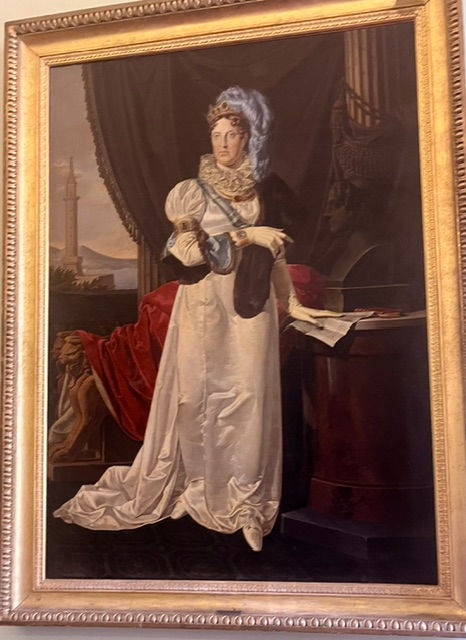
Two paintings hanging in the living quarters of the palace portray the King and Queen. She is statuesque, haughty with a strong chin and a penetrating stare. She has her left hand on a map on the table next to her. The portrait of Ferdinand shows an undistinguished middle-aged man with a big nose and fleshy features. He is pointing to his crown as if to say: “I am the King round here.”

We reached the rooms of the Royal couple which were lavishly and beautifully furnished with period pieces and paintings. What caught my eye was a great library attached to the Queen’s private quarters. It was very distinctive, laden with all the latest books of the day and antique globes attesting the known geography of the world at that time. The guide said pointedly this was the Queen’s domain.
Reconsidering Maria Carolina
In my subsequent research I found that modern scholarship has revealed Maria Carolina was highly educated and raised in the intensely political court of her mother, Maria Theresa, where she learned how to be a sovereign.
She was strategic, especially in foreign policy and was one of the most politically active queens in Europe. Cinzia Recca’s work on the queen’s correspondence shows that from the 1780’s onward and especially after the fall of the long serving first minister Bernardo Tanucci she was able to shape policy directly and her anti-French and Spanish positions were well known throughout Europe.
The negative portrayals of her as “weak and foolish” including in some Nelson biographies, were made largely by post-revolutionary Jacobin leaning writers who despised her anti-French stance, as well as nineteenth century historians who repeated these criticisms. She was painted as hysterical, meddling and intellectually limited – a canard attached to other politically active women, as all we now recognise.
Emma Hamilton and the Queen’s Agenda
Her relationship with Emma Hamilton has fascinated historians and biographers of Nelson. Was Emma manipulating the queen – as she later implied – for the sake of British interests? We know she cultivated the Queen’s trust and used her friendship with Nelson to elevate her own position in court. This may well be true – in part.
From the new scholarship we know that Maria Carolina was a person of education and intelligence. As a woman she understood Emma’s unique access to Nelson. No doubt, as the threats of revolution and French invasion increased, she saw Emma as a channel to influence British policy, especially during the years 1798-1799.
She understood Emma’s desire for royal favour, status and validation. Emma became fiercely loyal to her. Nelson became so convinced through this back-channel diplomacy that he fell in step with her view of British interests – which happened to coincide with Emma’s interests. Actions taken by Nelson subsequently attracted criticism and included helping with the abortive Neapolitan attack on Rome, assistance to the Royal Family in their flight to Palermo, support for their return to Naples and, controversially, assistance in arresting, trying and executing the enemies of the King and Queen. These included prisoners who had laid down their arms in return for a promise they would be sent to France. He also supported the Neapolitan claim on Malta, despite the strategic value of the island to Britain. For all these decisions, he found himself under increasing criticism until he was recalled to London in 1800.
Surely all these decisions were to some degree or other the Queen’s agenda. To me Emma was probably more manipulated than manipulator. Neither Nelson nor Emma ever seems to have considered this possibility suggesting the Queen was very persuasive and “played” them so well they didn’t recognise it was happening to them.
Rewards, Ruin and Silence
The relationship did not survive Nelson’s return to England. Perhaps the Queen felt that the title of Duke of Bronte bestowed on Nelson – though without the lands to support the title, - was reward enough. She made Emma a Dame of the female branch of the Sovereign Military Order of Malta – but no money. Perhaps she knew that both of them wanted recognition more than wealth? Emma’s later attempts to have her work recognised with a British government pension were unsuccessful. Was this because of her unsavoury reputation in England and her role in breaking up Nelson’s marriage or did it reflect a view that the “diplomacy” had hindered rather than helped Britain’s interests?
Nelson recovered from his mistakes in Naples after the Battle of Copenhagen in 1801 and following his death at Trafalgar in 1805, he became the Nation’s hero. As a result of her lavish spending habits and a less than generous settlement from Sir William and Nelson’s estates, Emma died in abject poverty in Calais in 1813. Joseph Bonaparte, Napoleon’s brother became the Ruler of Naples in 1806 followed by Caroline Bonaparte and her husband Marat who ruled at Reggio Caserta until 1815 when Ferdinand recovered his throne. Queen Maria Carolina lived in exile in Vienna from 1806 until her death in 1814. There was never any official or unofficial correspondence between her and Emma Hamilton after Nelson and the Hamilton’s returned to England in 1800.
Maria Carolina’s Final Reckoning
I have to say Maria Carolina, smart as she was, bears some of the blame for the breakup of Nelson’s marriage to my ancestor, Fanny. She helped create the feverish cabal of Emma, herself and Nelson which blossomed into Nelson’s affair with Emma. Reggio di Caserta remains a fit tribute to her reign. Napoleon Bonaparte has the last word. He said: “She was the only man in the Kingdom of Naples.”

To find out more about my novels and future book launches, sign up to ‘stay in touch’ on my author home page. My first novel in the trilogy, Nelson's Folly, is also available as an audiobook.


Comments